Stephen A. Nuño, Northern Arizona University
“I don’t see how the party that says it’s the party of the family is going to adopt an immigration policy which destroys families which have been here a quarter-century. I’m prepared to take the heat for saying let’s be humane in enforcing the law.” – Newt Gingrich, 11/22/2011
The immigration issue has been a lightning rod in politics over the last decade, however it is largely reflective of our country’s historical love-hate relationship with our newest members of society. The 2010 Census illustrates the growth of the Hispanic population in the United States in several ways that will quickly have an important impact on the political landscape. More than 25% of the Hispanic population is under five years old, and Hispanics make up 22% of the U.S. population under-18 years old.
Texas is now a majority-minority state, meaning ethnic minorities make up the majority of the population in a state that is worth thirty-eight electoral votes out of the 270 needed to win a Presidential election. This is important because if the GOP loses Texas it will be virtually impossible to win another presidential election. The recent federal court decision to draw three out of four new Congressional districts in Texas where minorities will make up the majority population underscores the need to come up with a plan to integrate Latinos into the GOP. There simply are not enough non-Hispanic whites in the South and the upper-Midwest to make a presidential election close.
Hispanics are also making political headway in places where they were previously non-existent. Recently, the former Senate President of Arizona, Russell Pearce, became the first elected representative in his position to be successfully recalled. The self-declared representative of the Tea Party took up the mantle against immigrants with the infamous SB1070 as well as a set of anti-immigrant proposals, which failed to pass, that would even make Alabama blush. Russell Pearce found himself in a district that is now 30% Hispanic and with a dominant Mormon community that is coming under increasing pressure from the Church to moderate their stance on immigration, lest they offend the fastest growing source of recruits to increase the flock in the country.
The growth in the Hispanic population means that decisions the political parties make today about the immigration issue can have deep consequences into the future. There are essentially two models of immigration that the parties have presented to the electorate, which I call the assimilation model and the criminal model. The assimilation model looks at immigrants as already existing members of society who operate outside the mainstream because of our defective immigration system. The focus on the assimilation model is coming up with ways to integrate these people into society. By contrast, the criminal model seeks to further isolate immigrants and force them to either leave the country or exist as illegitimate members of society.
The recent Republican debates have been a spectacle of remarkable alacrity to position immigrants as the enemy. In an amazing display of the indifference that personifies the GOP attitude towards the immigrant experience, Herman Cain said he would electrify the southern fence along the border with Mexico. However, President Obama has opened himself up to criticism because of his enforcement policy that has resulted in a million deportations and has left thousands of American citizens without their parents.
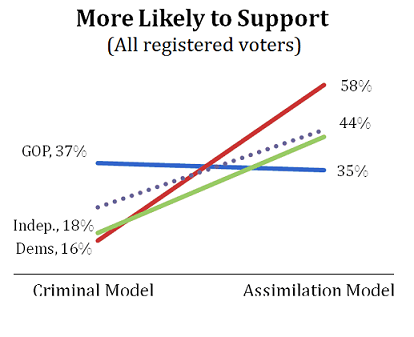
Both Democratic policy and Republican rhetoric seem to reflect the assumption that the criminal model of immigration is more favored among the electorate than the assimilation model. However, a recent Univision News/Latino Decisions poll suggests this may not be the case. Respondents were asked if they were more likely or less likely to support candidates who promoted an immigration system that reflected the criminal model or the assimilation model.
The first graph shows that among the overall national electorate, Democrats and Independents are more likely to support candidates who promote the assimilation model than Republicans. The dotted line represents all respondents. While 58% of Democrats are more likely to support a candidate who promotes the assimilation model, only 16% of Democrats were more likely to support candidates who promote the criminal model. Likewise, 44% of Independents were more likely to favor candidates who supported the assimilation model, while 18% said they were more likely to favor candidates who promoted the criminal model. Republican attitudes were largely reflective of the GOP primary debates, but GOP candidates do not gain any substantive advantage among Republican identifiers depending on support for the criminal or assimilation model.
The second graph illustrates respondents who said they were less likely to support candidates who promoted the criminal model or the assimilation model. Once again, Democrats were most supportive of the assimilation model. While 52% of Democrats said they were less likely to support a candidate who promoted the criminal model, only 9% of Democrats said they were less likely to support candidates who promoted the assimilation model. About 42% of independents said they were less likely to support candidates who promoted the criminal model, 21% said they were less likely to support candidates who promoted the assimilation model. Of the Republicans who were interviewed, 31% said they were less likely to support candidates who promoted the criminal model and 17% said they were less likely to support candidates who promoted the assimilation model.
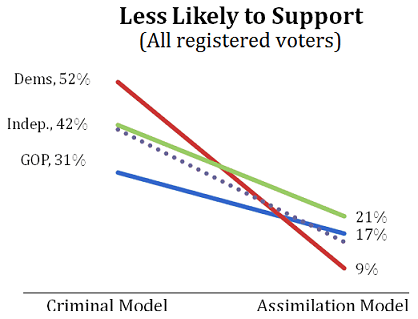
Overall, the story is that the assimilation model is more helpful and less harmful among Democrats and Independents, while the criminal model is only marginally helpful but relatively more harmful among Republicans.
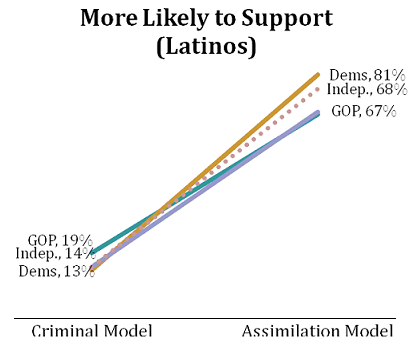
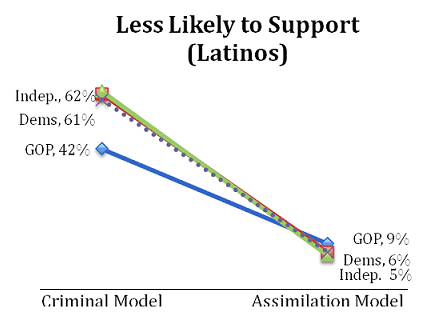
Latino Decisions also asked Hispanic voters about their support for candidates who promoted each immigration model. The third and fourth graphs show that Hispanics demonstrated uniform support across party identification for those candidates who promoted the assimilation model, with 81% of Democrats, 68% of Independents and 67% of Republicans saying they would do so. Latinos also saw the criminal model as a turn off, with 62% of Independents, 61% of Democrats and 42% of Republicans saying they were less likely to support a candidate who promoted the criminal model. While Latino Republicans did not show as strong as a reaction as Independents and Democrats, its important to understand that if the Republican Party is to increase its Latino membership, it will most likely come from Independents. The data suggests this is not very likely to happen unless the GOP can change their message on immigration. However, perhaps the most imperative news for the GOP today is that even Latino Republicans are strongly supportive of candidates who favor the assimilation model, while a significant amount of Latino Republicans are less likely to support candidates who promote the criminal model. The current Republican position on immigration coming from the primary candidates will not only garner almost no advantage among whites as discussed above, but risks further isolating the Party from a demographic it cannot afford to maintain its current trajectory it is to remain a competitive national Party into the future.
Perhaps this is why Newt Gingrich has been insistent on a moderate stance on immigration, despite the vociferousness of his detractors and largely reflective of the two GOP primary winners who preceded him, George W. Bush and John McCain. In the last debate, Gingrich said, “I don’t see how the party that says it’s the party of the family is going to adopt an immigration policy which destroys families which have been here a quarter-century. I’m prepared to take the heat for saying let’s be humane in enforcing the law.”
With the exception of Rick Perry, who appears to have difficulty articulating his position, Gingrich seems to have a polished message that appeals to electorate at large. This is not surprising since Gingrich was the first to start an online newspaper that covered Hispanic issues, The Americano, and he has been committed to learning Spanish so he can not only communicate with Hispanics, but also demonstrate genuine comfort with Hispanic culture.
The data from Latino Decisions and past surveys indicate that a humane approach to immigration is not only a better short term political strategy, but demographic shifts in the electorate present a compelling argument that a humane approach is a better long term strategy as well – for both political parties. While President Obama has long adopted the right rhetoric on immigration, his deportation policies have led many to question his commitment. On the other side, the only one among the current crop of Republican candidates who can see this, and understands it, Gingrich, is the one who also happens to be settling at the top of the GOP ticket at the right time.
Stephen A. Nuño, Ph.D. is an Assistant Professor in the Department of Politics and International Affairs at Northern Arizona University. His research focuses on partisan outreach to Hispanic voters, and has contributed commentary to The Americano in the past.