
In December 2005 H.R. 4437, aka the “Sensenbrenner Bill” was passed by the House of Representatives and the issue of immigration became front page news in American politics. The bill asked for the immediate deportation of all undocumented immigrants, and would make it a crime to assist undocumented immigrants in any way, punishable by up to 5 years in prison. The immigrant rights marches that occurred in the Spring of 2006 further highlighted the political importance of immigration reform within the Latino community, and with an estimated 5 million taking part in the rallies, demonstrated the mobilizing capacity of immigration as an issue.
Since 2006, immigration reform has continually been cited as one of the top issues of concern in the Latino community, and in the 2010 election immigration continued to play a major role in the minds of Latino voters. Latino Decisions election eve poll found that 60% of Latino voters stated immigration was “one of the most important issues” on election day 2010. Despite the salience of immigration, it was the one issue in which goodwill was not found during the lame duck session in December 2010, and the DREAM Act failed to pass in the Senate. Thus, the DREAM Act and immigration reform at large, still looms for the President, the Congress, and Latino electorate.
While the economy is an obvious issue of concern for Latinos and all Americans in 2011, the February 2011 impreMedia-Latino Decisions tracking poll found strong evidence that immigration in general, and the DREAM Act specifically, continue to rank high on the Latino agenda. Overall, 47% of Latino registered voters stated immigration was currently the most important issue facing the Latino community, while 85% said they supported the DREAM Act.
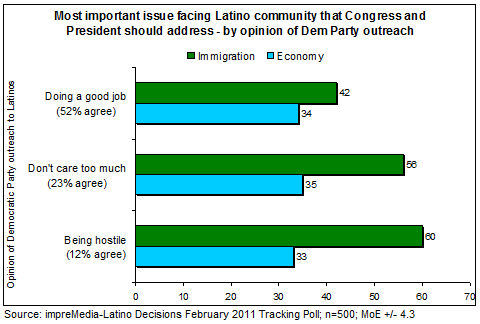
Though the vote on the DREAM Act is in the past, it could still loom large in 2011-12 as Latino voters ask both parties what they have accomplished on this very important issue. Indeed, there is some evidence in the impreMedia-Latino Decisions tracking poll that the lack of progress on immigration may be hurting opinions of the Democrats, not just Republicans. Voters were asked to assess how good or poor of a job each party was doing in their outreach to Latino voters. Among those who said the Democratic Party was doing a good job reaching out to Latinos, 42% cited immigration as their top concern for lawmakers to address. In contrast, those who rated Democratic outreach unfavorably were more likely to state immigration was the number one priority. Among those who said the Democrats don’t seem to care about Latinos, 56% called immigration the top issue, and among those who thought the Democrats were being hostile to Latinos, 60% said immigration was the most important issue for Congress and the President to address. By comparison, opinions of Democratic outreach do not appear to be correlated at all with concern over the economy, perhaps because considerable attention is being paid to the economy. In contrast, the major accomplishments on immigration over the past two years have been to approve $600 million for border security coupled with a significant growth in raids and a“dramatic increase” in deportations.
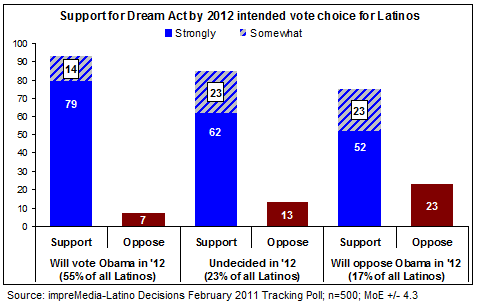
Looking to 2012, it is clear that immigration and the DREAM Act will still be on the minds of Latino voters. As a recap, 60% said immigration was one of the most important issues in the 2010 election, and 47% said it was the top issue in February 2011 – more than any other issue. Not surprisingly, support for the DREAM Act is strongest, indeed almost universal, among those who say they will vote for Obama in 2012. We broke out support for the DREAM Act by intended vote choice in 2012 and found regardless of how Latinos will vote, a very strong majority support the DREAM Act. Among Obama voters, 79% strongly support and 14% somewhat support the DREAM Act – that’s 93% support for seeing this bill passed among the President’s Latino base. Further, among those who say they are undecided 62% strongly support DREAM with 23% somewhat support, all told 85% in favor. Even among those who plan to vote for a GOP candidate in 2012, Republican contenders should take note, that Republican leaning Latinos also supported the DREAM Act by a big margin: 52% strongly support and 23% somewhat support, totaling to 75% approval of the bill.
As the 2012 presidential election already starts to take shape, we will hear candidates make all sorts of statements about immigration reform, whether they are promises of reform or attacks on undocumented immigrants. Either during the primary debates or the general election, the candidates will be asked if they support or oppose legislation like the DREAM Act, and without a doubt, Latino voters will be paying close attention.


it shold be passed
The Dream Act, was the first step in the right direction in solving the problem of illegal immigration.
The steps required to obtain legal status in the country for the children of illegal immigrants would require that within the six year period of temporary residence, student’s must have received a degree from an institution of higher education in the United States or completed at least 2 years, in good standing, in a program for a bachelor’s degree or higher degree in the United States,” or have “served in the uniformed services for at least 2 years.
The bill would have provided under its provisions, immigrants that would make a significant contribution, economically, as well as militarily. The Dream Act was not intended to be A free path to citizenship as led to believe by the opponents of the bill, but a challenge to each and every individual involved in the program.
Republicans who strongly opposed the bill, calling it another form of amnesty, and a reward for illegal entry into the country were successful in their opposition, not withstanding the advice given by top officials of the Pentagon who favored the bill along with various civil rights groups.
G.O.P. constituents made their voices heard in the November elections. Top and foremost on their agenda was immigration, which included blocking any attempt in providing a path for the children of illegal immigrants to become lawful citizens. Could this have been a once in a life time opportunity for America to finally establish a blue print for all future immigration policies?
Tensions run deep when it comes to immigration. Negative publicity on the matter has played a major role in not being able to find a practical, and logical solution to the problem.
Immigration reform is temporally out of service in Washington. Unfortunately the innocent children of undocumented aliens are caught up in the middle of a political feud between the Hatfield’s, (Democrats) and McCoys,( Republicans) with no bipartisan relief in sight. In addition, they face a nation unwilling to take into consideration the circumstances that led to their predicament.
We identify ourselves as a nation of immigrants, and our assessment is correct. At the present time the country seems to be suffering from mass amnesia. Perhaps we should all take a closer look in the mirror, It might just bring back to memory, what America is composed
This is the kind of blog I have been hunting for now, for several years. Professional staff and wonderful writing that is not ethnocentric in any way. It is the type of blog where I believe one could go to have an interesting group of voices espousing many, many views. I would welcome a dialogue friendly way in which to address various and sundry issues – is this that forum?
I will readily admit that I am a professional man with probably more education than any one human being should have and I grew up in the suburbs of Los Angeles where, in my time being there it was not such an enormous situation, perhaps due to the amount of Latino’s living there. I will also admit that I do maintain a blog here at WordPress that is not particularly impressed with the indecisive, and “inactive government in matters of immigration reform.”
I do look forward to continue coming over and hopefully we’ll be able to engage in civil discourse about the plight of Latino’s. Thank you.
If the recent Chicago elections are any indication, the DREAM Act is not at all important to voters. Most of the candidates strutted around in the media proclaiming their undying support for this ridiculous piece legislation and attacked Rahm Emanuel for having fought against so called immigration reforms in the past. The result? Emanuel won by a landslide and gained a big portion of the legal hispanic vote despite having two other well known hispanic candidates running against him.
The DREAM Act as a political issue is simply a form of race baiting. The fact of the matter is that most of those surveyed likely knew very little about the provisions of the bill and even a smaller percentage of them likely even read it.
I am a Latino Chicago Democrat and I won’t ever place a vote in support of any legislator who would want to pass such an irresponsible piece of legislation into law.
I’m not certain I agree. My staff spent 267 days canvassing and talking with Latino voters in Las Vegas since 2009. At the peak of Immigration fight throughout the southwest in 2010 Latino voters still overwhelmingly stated that Jobs/Economy was the most important issue to them and their families. What we saw was that Immigration is a motivating issue but not a decision issue. Let’s be clear…Latino Voters are more sophisticated in their decisions than ANYONE gives them credit for. If anyone wants the Latino Vote know that it takes resources and time to reach them. Thanks for the added research Matt. @Jim – That data does exist.
Why should Latinos vote for Democrats if democrats continue to ignore the issue of immigration reform which is our number one priority? Moreover, we voted for Obama in 2008, who promised to reform immigration and we are still waiting for a bill to address immigration reform. Democrats take the Latino vote for granted, so we have to demonstrate to them that we mean business. So my suggestion is let’s show them in 2012 and vote for an alternate candidate or let’s think Republican Party here we come!!! But we should ask Republicans and Democrats what is their pledge towards immigration reform before Latinos vote for them.
In reviewing the many news articles published and broadcast by English- and Spanish-language media — along with the comments by their respective audiences — it is obvious that many non-Hispanic Americans are unaware of the the proportion of native-born U.S. to the naturalized and undocumented Latinos in the USA. Is there a recent analysis of such percentages? Such information would go a long way towards underscoring the growing influence of Latinos in this country; not only as consumers, but as taxpayers and voters.