
Latinos Make their Mark: Demographics, Destiny and Reapportionment

Four weeks ago the US Census Bureau gave the nation a first glimpse at the 2010 data. Over 308 million people live in the United States now; a 10% increase since 2000. While an additional 27.3 million new residents is indeed news, the big story is reapportionment. Latinos are driving the very growth and regional population shifts that determined the decennial distribution of Congressional seats.
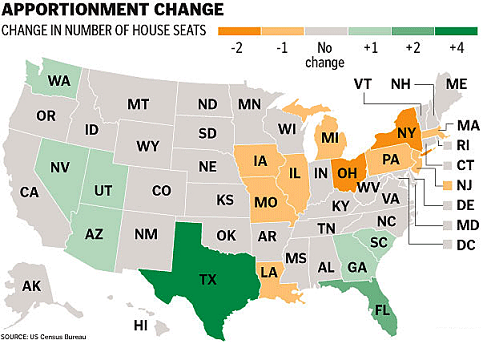

As the Boston Globe map above nicely illustrates, only eight states will gain Congressional representation: Texas picks up four seats, Florida two, Arizona, Nevada, Utah, Washington, Georgia and South Carolina each add one.  Larger Latino presence in these states was essential to gaining additional representation.   The 2010 ethnic and racial composition data are not yet public, but comparing 2000 and 2009 Census data it is evident that congressional delegation growth is attributable to Latino-specific population growth in these states.  As the figure below illustrates, the Latino share of state populations increased in every case. This is not a regional phenomenon: in 35 states across the country, their population more than doubled.

State Latino Population Growth 2000-09 (Haz click aquí for enhanced graphic)

It is true that non-Latinos also netted gains, but Latinos out-paced others by rather strong margins.  Some states, including Louisiana, Rhode Island and Michigan actually had a net loss of non-Latinos and grew only because Latino increases offset the non-Latino population dip.  With all of these details in mind, it is fair to say that all new districts are Latino districts.

Let’s take a look at Texas, the big winner in reapportionment.  The Texas delegation on Capitol Hill will grow to thirty-six as a function of the 2010 reapportionment.   If the Latino population had gone unchanged over the past decade (remaining at the year 2000 level) the state would only have grown by 7%.  In that event, Texas would not pick up a single seat. All states gaining MCs this round have increases in state population of at least 14%.  To put a fine point on it — Missouri’s population grew by exactly 7% and lost a seat (see first map above).  The map below shows the extent to which Latinos influenced population change within each state.  The shading scheme accounts for the share of growth attributable to Latinos.  For example, over the last ten years, Texas population grew by an astonishing 20.6%, adding 4.3 million more people to the state.  Between 2000 and 2009, Texas added nearly 2.5 million Latinos, accounting for 63% of the overall population increase.


Latino Share of State Population Increase 2000 Census -2009 ACS


Census and apportionment formulas include all US residents, irrespective of age or citizenship status.  Legislative districts are drawn to represent the totality of the resident population.  The vast majority of state and local districts also employ Census resident population data to allocate districts and re-draw lines.  Elected officials, no matter their office, are charged with representing all of their constituents, not just voters or contributors.  If democratic (small “d”) representation is working as it should, then Latinos should see their preferences on a broad range of issues increasingly reflected in legislation and public policy.  Alas, all is not so straightforward in Latino American politics.

The difficulty for Latinos in the reapportionment and representation process is this: states will gain legislative representation due to surges in Latino population, yet millions contributing to the net population growth are not able to vote due to age or citizenship status.  One-third of all Latino American citizens are too young to vote, and another 12.8 million Latinos are not eligible due to citizenship status.   Furthermore, recent years have seen politics fueled with anti-Latino rhetoric and policy agendas that are diametrically opposed to Latino preferences.  Thus, it is uncertain how much substantive or descriptive representation Latinos stand to gain from upcoming redistricting despite their obvious national presence.  It would be a horrible irony to see states adding congressional seats because of Latino growth, only to design districts and/or elect representatives with legislative agendas antagonistic to Latino interests in the state.  Once states have re-drawn their new districts, it will be worth revisiting how Latinos factored into deliberations and the prospects for increased representation.

Subscribe

, , , ,

11 Responses to Latinos Make their Mark: Demographics, Destiny and Reapportionment

  1. oscarvalles 03/03/2011 at 6:40 am #

    @arbitrista, I know that states are able to determine the number of eligible voters given the census data. Census data is something states need to do their own redistricting (i.e. draw new district boundaries). Now whether voting eligibility is captured during the census process or projected by either the federal government or state government is not known to me, but I’m sure there is a check during the apportionment process. Otherwise, 40+ states would be sharing the same gripe.

    As to the contributor’s of this blog, I am surprised a serious blog has been dedicated to Latinos and politics. Nice work.

  2. el_votante 01/17/2011 at 6:39 pm #

    This is exactly what I have been telling people – that Latino population growth was the real reason any of these states gained new seats – thank you for this excellent analysis. Let’s just hope that the lawmakers and so-called independent commissions do the right thing and actually draw some new Latino seats in Congress. By my count, 6 new Latino seats can be created in the states that gained, and even a few more Latino seats can be drawn in states that stayed even, such as CA or CO. All told, if this is done “correct” as per the VRA, we should see 8 new Latino seats in Congress in 2012.

  3. Janet L. 01/17/2011 at 12:48 pm #

    Even if someone is not a citizen, they might be a legal permanent resident, on a permanent visa, or be in the current process of becoming a citizen. Everyone who resides in the United States is subject to the laws, policies, and pays taxes. Therefore the Constitution now requires one-person, one-vote, so that means every congressional district must have the exact same number of people. This is a principal of fairness and equality. The same argument could be applied to those under 18, or people who don’t own property. The argument you are making is about having a stake in the system, and anyone who is a resident clearly does.

  4. arbitrista 01/17/2011 at 4:07 am #

    I don’t have any clear thoughts about the issue, but does the profound disjuncture between apportionment and citizenship status raise the question of whether we should apportion seats based on residency as opposed to citizens? Under the current system we have something that approximates that old 3/5 clause, in which slaveowners received greater political power than their numbers indicated. In principle I don’t think this necessarily is anti-immigrant, because one could have a situation in which people work in the U.S. without any intention of becoming citizens. Of course I don’t know enough about the counting procedure to know whether this is already accounted for in some way.

Trackbacks/Pingbacks

  1. The Floridian Five « darrengrem - 01/30/2012

    [...] nuanced as you get in conservative circles these days on the issue, to be honest.   Given that, as noted in a recent report by Sylvia Manzano at TAMU, just because population changes and reapportionment have “increased” the relative [...]

  2. Redistricting and the Latino Boom in Nebraska « Latino Decisions - 06/01/2011

    [...] alluded to in the introduction, the Nebraska case is by no means an isolated issue. As depicted here before, the rise in Latino population ensures that many states will wrestle with similar issues [...]

  3. Latinos Make their Mark: Demographics, Destiny and Reapportionment » Hispanic Market Info - 04/19/2011

    [...] more information on the following post visit: http://www.latinodecisions.com/blog/2011/01/17/demographics-destiny-and-reapportionment-2/ Share and Enjoy: Tagged with: census 2010, latino decisions blog, latinos and the census, [...]

  4. Latino influence states even more important in 2012 electoral college map « Latino Decisions - 01/24/2011

    [...] Latinos Make their Mark: Demographics, Destiny and Reapportionment [...]

  5. Compton: A shifting population, except in City Hall | MULTI-AMERICAN - 01/21/2011

    [...] edge, at least not yet. As we pointed out earlier this week, the polling firm Latino Decisions recently delivered this analysis in relation to the census: The difficulty for Latinos in the reapportionment and representation [...]

  6. More sense of the census: Analysis looks at Latino population growth and reapportionment | MULTI-AMERICAN - 01/19/2011

    [...] Decisions has distilled the early information, along with annual census data since 2000, into an analysis of Latino population growth and its political [...]

  7. Latinos Drive Reapportionment Yet Increased Representation Uncertain : La Plaza - 01/18/2011

    [...] Latino Decisions [...]